What has become an important to the country of Bulgaria to bring in foreign currency
Published equally office of the ECB Economic Message, Issue half-dozen/2020.
The Bulgarian lev and the Croatian kuna were included in the substitution rate mechanism (ERM II) on x July 2020. The conclusion was taken by common understanding of the finance ministers of the euro area countries, the President of the European Central Bank, and the finance ministers and key bank governors of Denmark, Republic of bulgaria and Republic of croatia. This followed a common procedure involving the European Commission and the Economical and Financial Committee. The beginning of ERM 2 participation marks the concluding step of a detailed roadmap. This roadmap set out a process which was characterised by constructive collaboration between the Bulgarian and Croatian regime and the ERM Ii parties and based on thorough economic assessments and the principle of equal handling.
ERM II was introduced in 1999 as one of the means to assess a country'southward convergence with the euro expanse. The mechanism has two primary purposes. The kickoff is to human action as an arrangement for managing the commutation rates between the currencies of the participating countries and the euro, and the second is to assist with the assessment of convergence for the adoption of the euro equally established by Article 140 of the Treaty on the Functioning of the European Union. Therefore, participation in ERM II is not only legally at the core of the convergence benchmark on exchange charge per unit stability, it is also a means of testing the sustainability of convergence before and later on adoption of the euro. As participating in ERM Ii for at to the lowest degree two years without severe tensions is a precondition for the eventual adoption of the euro, all EU Member States are expected to join the machinery at some stage.
ERM Ii is a multilateral arrangement of fixed, simply adjustable, substitution rates which provides for a fundamental exchange rate betwixt participating currencies and the euro and a fluctuation band with a standard width of ±xv% around the central charge per unit. Other master features are central banking company interventions at the margins of the agreed fluctuation band and the availability of very short-term financing from participating fundamental banks. When joining ERM 2, national primal banks can unilaterally commit to a narrower fluctuation band than that provided for by ERM Two, without imposing whatsoever additional obligations on the ECB or the other participants in the mechanism.[1] During ERM Two participation, realignments of the central rate (as has happened in the past with the Slovak koruna) or changes to the width of the fluctuation band may be necessary every bit a result of significant changes in the equilibrium exchange rate of a given participating country or in the presence of inconsistent economic policies. Interventions at the margins of the fluctuation bands are in principle automatic and unlimited. Notwithstanding, the ECB and the participating national key banks tin suspend these interventions at whatever time if they conflict with the primary objective of maintaining price stability.
Experience shows that ERM II can accommodate different commutation rate regimes, as is now the example with those of Bulgaria and Croatia. The mechanism provides sufficient room for adjustment to shocks and market developments. At the same time, the mechanism may incorporate, every bit a unilateral commitment, tightly managed or pegged exchange rate regimes, and even currency board arrangements.[2] A currency board system was used by Eesti Pank and Lietuvos bankas before euro adoption and is beingness used today by Българска народна банка (Bulgarian National Bank). Hrvatska narodna banka maintains the stability of the exchange charge per unit of the kuna against the euro in club to achieve its primary objective of price stability, but does not commit to a fixed exchange rate. In any event, all participating countries are required to stay in the mechanism for at least ii years before the convergence reports prepared by the ECB and the European Commission may provide a possible positive assessment with regard to adoption of the euro.[3]
The process leading to ERM Two participation has evolved over time, but always relies on the principle of equal treatment. When the last wave of countries joined ERM Two, more than xv years ago, participating in the machinery required making and publishing a business firm, but general, commitment to pursue stability-oriented policies. In the subsequent years, a number of important policy lessons were learned from the global financial crisis. The crunch affected not only the euro expanse, but likewise several countries whose currencies were participating in ERM Two. Euro area governance was reformed following the crunch, resulting in tighter economical and fiscal surveillance and the institution of the banking union. During that period it was besides improve understood that participation in ERM Two may take important implications, every bit it constitutes a regime shift that tin alter the economic incentives of international and local investors. In particular, after joining the mechanism, gross capital inflows other than strange direct investment accelerated sharply in several countries, also in comparison with other countries in the region during the same period. In some cases this proved to be unsustainable, leading to episodes of major capital catamenia retrenchment in the subsequent years.
A fundamental lesson learned from the global financial crunch was that, in the run-up to euro adoption, a loftier level of institutional quality and skilful governance help to reduce the risk of a build-upward of excessive imbalances. Greater structural resilience creates the preconditions for allocating capital to productive firms instead of rent-seekers, thus supporting the catching-up process rather than the formation of bubbles. Moreover, proficient governance implies that policymakers are able to resist pressure from vested interests against the implementation of necessary reforms and the building-up of buffers in normal and practiced times, including countercyclical macroprudential and fiscal measures. In the past few years these lessons and developments have been reflected in the roadmap to ERM II designed by the national authorities of Republic of bulgaria and Croatia in cooperation with the ERM Two parties.
The inclusion of a currency in ERM Two follows the procedure outlined in the Resolution of the European Council of 16 June 1997. [4] Decisions on ERM 2 participation are taken by common understanding of the ERM 2 parties, which means achieving a consensus about the pursuit of sustainable policies by the Fellow member Country requesting the inclusion of its currency in ERM II. At the same time, it has more recently been antiseptic that reaching this consensus depends on three fundamental factors: (i) reflecting the lessons learned from by crises; (ii) taking into consideration the introduction of the banking union; and (iii) recognising the need to have due account of any state-specific vulnerabilities that need to be addressed to ensure smooth participation in the commutation rate machinery.
Based on this arroyo, the Bulgarian and Croatian authorities identified a number of prior policy commitments, which were formally adopted in the summer of 2018 by Republic of bulgaria and in the summertime of 2019 past Croatia. They were designed in collaboration with the ERM Two parties and had to be voluntarily fulfilled before starting ERM 2 participation. These commitments reflect the current reality in a way that is reasonable, proportional and motivated. In particular, the commitments accept to be specific, realistic and verifiable in nature and they have to exist implemented, monitored and verified within a relatively short space of fourth dimension. Their fulfilment has been monitored and assessed by the ECB and the European Committee, each in their corresponding field of competence, namely banking supervision and macroprudential policy for the ECB and structural policies for the European Commission (fiscal policies fall nether the provisions of the Stability and Growth Pact).
With a view to ensuring a sustainable convergence path to the euro area, Republic of bulgaria and Republic of croatia fabricated additional policy commitments when they joined ERM Ii on ten July 2020. [5] In line with past practices, Bulgaria and Croatia made voluntary policy commitments, the so-called postal service-entry commitments, when they began their participation in ERM 2. The agreement on participation of the Bulgarian lev and the Croatian kuna in ERM II has also been accompanied by a firm commitment by the respective national regime to pursue sound economic policies with the aim of preserving economic and financial stability and achieving a high degree of sustainable economic convergence. The regime, together with the responsible European Wedlock bodies, volition closely monitor macroeconomic policy developments and the implementation of these policy measures, in the appropriate frameworks. All in all, the process leading to ERM 2 entry has acted equally a catalyst for reforms that will mitigate risks under ERM Two with a view to subsequent euro adoption. Although these reforms exercise no eliminate risks, their importance in preparing for sustainable participation in the monetary spousal relationship should not be underestimated.
The Bulgarian lev and the Croatian kuna were included in ERM Ii with their electric current exchange charge per unit levels. The Bulgarian lev has been included in ERM II with a cardinal substitution charge per unit of i.95583 levs per euro, which corresponds to the fixed exchange rate under Republic of bulgaria's currency board system. The Croatian kuna has been included in ERM Two with a central exchange rate of vii.53450 kuna per euro, which corresponds to the prevailing marketplace rate at the time of its inclusion on 10 July 2020.
The inclusion of both currencies at their current exchange rate reflects the fact that Bulgaria and Croatia take a remarkable track record of commutation rate stability, under which both economies have undergone significant external aligning. For more than two decades Българска народна банка (Bulgarian National Bank) has operated a currency board arrangement nether which information technology commits to exchange levs confronting the euro at a fixed exchange charge per unit. Hrvatska narodna banka has maintained a managed floating substitution charge per unit authorities under which the kuna fluctuates within a relatively narrow range around its boilerplate exchange rate against the euro. While fundamentally different in their functioning, both regimes accept served their economies well. In item, they proved resilient in periods of severe fiscal marketplace stress, including during the ongoing coronavirus (COVID-19) pandemic. Moreover, both countries underwent pregnant external adjustment later on the onset of the global financial crunch. This involved the correction of large electric current account deficits, which have since turned into surpluses. Equally a upshot, there has been a sizeable reduction of net external liabilities, with both cardinal banks accumulating comfortable buffers in terms of foreign exchange reserves.
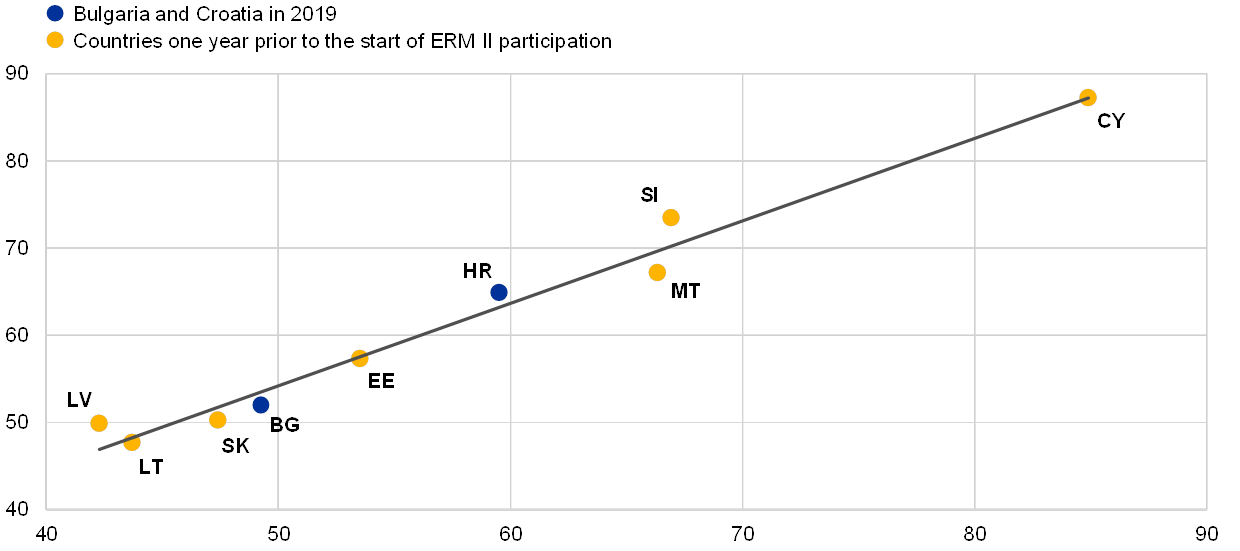
External rebalancing has been coupled with nominal adjustment in both countries, with price levels clearly reflecting the state of convergence of the two economies. Both countries recorded substantial increases in prices and costs before the global financial crisis. These were partly a by-product of the real convergence process, i.due east. the fact that both countries were catching up in terms of income levels relative to the rest of the Eu. Conversely, the global financial crisis brought about some correction of price and price levels in both Bulgaria and Croatia. Every bit a result, their toll levels relative to the euro area are now well in line with their income levels relative to the euro surface area. While such levels remain significantly below that of the euro area, this does non in itself constitute an impediment to participation in ERM 2. Past experience has in fact shown that countries that join ERM II at comparable or fifty-fifty less advanced stages of convergence tin can later on innovate the euro in a successful way. In this regard, a more important prerequisite for successful participation in ERM II is that price levels are commensurate with income levels (equally shown in Chart A) and, more mostly, with the economical fundamentals of the country.
Chart A
GDP per capita and price levels relative to the euro surface area
(percentages; x-axis: Gross domestic product per capita relative to the euro area; y-axis: price level relative to the euro area)
Source: ECB.
Source: https://www.ecb.europa.eu/pub/economic-bulletin/focus/2020/html/ecb.ebbox202006_01~db5e37768d.en.html
0 Response to "What has become an important to the country of Bulgaria to bring in foreign currency"
Post a Comment