what is a portion of corporate profits paid to stockholders
Due south-Corporations (S-Corps)
S corporations elect to laissez passer corporate income, losses, deductions, and credit through to their shareholders for federal tax purposes.
Learning Objectives
Describe the characteristics of an Southward corporation
Key Takeaways
Central Points
- In terms of federal income revenue enhancement, S corporations resemble partnerships in that income, deductions, and revenue enhancement credits period through annually to shareholders, regardless of whether distributions are fabricated.
- Payments are distributed to S shareholders tax-free to the extent that the distributed earnings were not previously taxed.
- Unlike a C corporation, an S corporation is not eligible for a dividends received deduction, nor is it subject to the 10 percent of taxable income limitation applicative to charitable contribution deductions.
Key Terms
- S corporation: a legal designation of companies that elect to pass income, losses, deductions, and credit through to their shareholders for federal tax purposes
- shareholder: Ane who owns shares of stock.
- C Corporations: whatever corporation that, under United States federal income tax law, is taxed separately from its owners
- dividends: Dividends are payments made by a corporation to its shareholder members. It is the portion of corporate profits paid out to stockholders.
S corporations elect to laissez passer corporate income, losses, deductions, and credit through to their shareholders for federal tax purposes. S condition combines the legal surroundings of C corporations with partnership-like federal income taxation.
Like a C corporation, an South corporation is generally subject field to the laws of the country in which it is organized. However, in the fashion of a partnership, an Due south corporation's income, deductions, and tax credits flow through annually to shareholders, regardless of whether distributions are fabricated. Thus, income is taxed at the shareholder level and non at the corporate level, and payments are distributed to Southward shareholders tax-free to the extent that the distributed earnings were not previously taxed.
Certain corporate penalty taxes (e.g., accumulated earnings tax, personal holding visitor taxation) and the alternative minimum revenue enhancement practice not apply to an S corporation. Unlike a C corporation, an S corporation is not eligible for a dividends received deduction, nor is it subject to the ten percent of taxable income limitation applicable to charitable contribution deductions.
In lodge to exist eligible for Southward corporation condition, a corporation must encounter certain requirements:
- Be an eligible entity (a domestic corporation, or a limited liability company which has elected to be taxed as a corporation)
- Accept but ane grade of stock
- Have no more than 100 shareholders
- Spouses are automatically treated as a single shareholder. Families, defined as individuals descended from a common ancestor, plus spouses and former spouses of either the common ancestor or anyone lineally descended from that person, are considered a single shareholder equally long as any family member elects such treatment.
- Shareholders must be U.S. citizens or residents and natural persons, so corporate shareholders and partnerships are by and large excluded. Withal, certain trusts, estates, and revenue enhancement-exempt corporations, notably 501(c)(3) corporations, are permitted to be shareholders.
- Profits and losses must be allocated to shareholders proportionately to each i's interest in the concern.
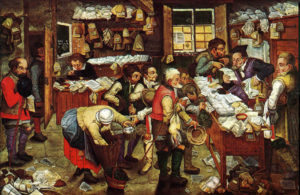 Pieter Brueghel the Younger, Paying the Revenue enhancement (The Taxation Collector): S corporations are non burdened with double revenue enhancement.
Express Liability Companies (LLCs)
An LLC is a hybrid business entity which has characteristics of both a corporation and a partnership, or sole proprietorship in some cases.
Learning Objectives
Discuss the advantages and disadvantages of express liability companies
Primal Takeaways
Key Points
- The main characteristic an LLC shares with a corporation is limited liability, and the primary characteristic it shares with a partnership is the availability of pass-through income tax (i.e. no double tax).
- An LLC is often more flexible than a corporation, and information technology is well-suited for companies with a single owner.
- At that place are a number of advantages and disadvantages associated with LLCs, and many of the specific advantages and disadvantages relate to certain states and districts.
Key Terms
- double taxation: Double taxation is the levying of tax past 2 or more jurisdictions on the aforementioned declared income (in the case of income taxes), asset (in the case of uppercase taxes), or financial transaction (in the case of sales taxes). This double liability is oftentimes mitigated by tax treaties between countries.
Limited Liability Companies (LLCs)
A limited liability visitor (LLC) is a hybrid business entity that has characteristics of both a corporation and a partnership (or sole proprietorship depending on how many owners). An LLC, although a business organization entity, is a type of unincorporated clan and is not a corporation (calling it a limited liability corporation is wrong). The principal characteristic an LLC shares with a corporation is limited liability, and the primary characteristic information technology shares with a partnership is the availability of pass-through income tax (i.e. no double taxation). It is often more flexible than a corporation, and it is well-suited for companies with a single possessor.
Membership interests in LLCs and partnership interests are besides afforded a meaning level of protection through the charging guild mechanism. The charging order limits the creditor of a debtor -partner or a debtor-member to the debtor'southward share of distributions, without conferring any voting or management rights on the creditor. Limited liability company members may, in sure circumstances, also incur a personal liability in cases where distributions to members render the LLC insolvent.
Advantages
Some advantages of LLCs include the following:
- selection of tax regime: an LLC can choose to be taxed equally a sole proprietor, partnership, S or C corporation;
- much less administrative paperwork and record keeping than a corporation;
- pass-through taxation (i.e., no double taxation), unless the LLC elects to be taxed as a C corporation;
- less chance to be stolen past fire-sale acquisitions (more than protection against hungry investors).
Disadvantages
Some disadvantages of LLCs are listed below.
Country laws regarding stock corporations are very well developed and provide for a diversity of governance and protective provisions for the corporation and its shareholders. However, most states do not dictate detailed governance and protective provisions for the members of a limited liability company. Thus, in the absence of such statutory provisions, the members of an LLC must establish governance and protective provisions pursuant to an operating agreement or similar governing document.
It may be more hard to raise financial capital for an LLC as investors may be more comfortable investing funds in the better-understood corporate form with a view toward an eventual IPO.
Many jurisdictions levy a franchise tax or majuscule values tax on LLCs. In essence, this franchise or business concern privilege tax is the fee the LLC pays the state for the do good of limited liability. The amount of the franchise tax can be based on the following:
- revenue,
- profits,
- number of owners,
- corporeality of capital employed in the state.
There tin can also be some combination of the to a higher place factors, or simply a flat fee.

YouTube Headquarters: A famous company that started out as an LLC is YouTube.
Publicly Held Corporations
Government-owned companies are either partially or fully owned by a regime and have both a distinct legal class and commercial presence.
Learning Objectives
Distinguish betwixt a land-owned enterprise, government-linked company, and quasi-governmental organization
Key Takeaways
Cardinal Points
- There are many possible levels of authorities interest in publicly-endemic companies. Governments can fully or partially own a company too as ain regular stock.
- While they may also have public policy objectives, publicly-owned companies are differentiated from other forms of government agencies or state entities established to pursue purely non-financial objectives.
- Regime-linked companies and quasi-governmental organizations also provide ways for government to be involved in corporations, either through a holding company or through government funding.
Key Terms
- state-endemic enterprise: A legal entity created past a government to undertake commercial activities on behalf of an possessor government.
- authorities-linked visitor: A private or public corporate entity in which an existing government owns a stake through a holding company.
- quasi-governmental organization: A corporation, business organisation or agency that is regarded by national laws and regulations every bit being under the guidance of the regime, simply also split from the regime.
There is no standard definition of a publicly-endemic corporation or state-owned enterprise (SOE), although the two terms tin can be used interchangeably. Their defining characteristics are their distinct legal form, and their operation in commercial affairs. While they may also have public policy objectives, SOEs are different from other government entities established to pursue purely not-financial objectives.
Land-owned enterprises can be fully or partially owned by the government. However, the line beyond which a corporation must exist considered "country-endemic" is unclear, equally governments can also own regular stock and have no special influence over business. For instance, in 2007 the Chinese Investment Corporation agreed to larn a 10% interest in the global investment banking company Morgan Stanley, but it is unlikely that this would qualify the latter equally a government-owned corporation. SOEs are oftentimes the effect of corporatization, a process in which authorities agencies are re-organized as semi-autonomous corporate entities.
The term government-linked company (GLC) is sometimes used to refer to private or public corporate entities in which an existing government owns a stake through a holding company. There are multiple ways of defining GLCs, depending on the proportion of the corporate entity a authorities owns. One rationale for calling a visitor a GLC is whether or not a government owns an effective controlling involvement (>l%); another possible definition defines as a GLC any corporate entity that has a regime every bit a shareholder.

Fannie Mae Headquarters: Fannie Mae was created by the The states government to expand the secondary mortgage market.
A quasi-governmental organization is a corporation, business or agency that is regarded by national laws and regulations as being under the guidance of the regime, but likewise carve up from the government. While they may receive some revenue from charging customers for services, these organizations are often at least partially funded by the regime. Sometimes they are even propped upwardly with cash infusions in times of crisis to aid offset situations that would bankrupt a normal privately endemic business.
A notable example of an SOE is the Saudi national oil company, Saudi Aramco, which the Saudi regime bought in 1988. The Saudi government also owns and operates Saudi Arabian Airlines, every bit well every bit many other companies.
Nonprofit Organizations (NPOs)
A nonprofit arrangement is an organization that uses surplus revenues to achieve goals rather than to distribute them equally profit or dividends.
Learning Objectives
Describe the types of nonprofit organizations, also every bit their legal aspects and organizational goals
Fundamental Takeaways
Fundamental Points
- While not-for- profit organizations are permitted to generate surplus revenues, they must be retained by the organization for its self-preservation, expansion, or for other plans.
- The two major types of nonprofit organizations are membership and board-only. A membership system elects the board, has regular meetings, and the ability to meliorate the bylaws. A lath-only organization typically has a self-selected board.
- Some NPOs may as well be a charity or service organization; they may be organized as a non-for-profit corporation or equally a trust, a cooperative, or they exist informally.
Key Terms
- revenues: In business, revenue or turnover is income that a company receives from its normal concern activities, ordinarily from the sale of goods and services to customers.
- nonprofit corporation: a visitor that uses surplus revenues to achieve its goals rather than distributing them as profit or dividends
Nonprofit Organizations
A nonprofit organization (NPO) is an arrangement that uses surplus revenues to reach its goals rather than to distribute them as profit or dividends. While non-for-profit organizations are permitted to generate surplus revenues, they must exist retained by the organization for its self-preservation, expansion, or for other plans. NPOs have controlling members or boards. Many have paid staff, including management, while others utilise unpaid volunteers and even executives who work with or without compensation (occasionally nominal). Where in that location is a token fee, in general, it is used to meet legal requirements for establishing a contract between the executive and the organisation. The extent to which an NPO can generate surplus revenues may exist constrained, or apply of surplus revenues may be restricted.
The two major types of nonprofit organizations are membership and board-only. A membership organization elects the board and has regular meetings and power to better the bylaws. A board-only arrangement typically has a self-selected board, and a membership whose powers are limited to those delegated to it by the board. A board-just arrangement'south bylaws may even state that the system does non have any membership, although the arrangement's literature may refer to its donors as members; examples of such organizations are Fairvote and the National Organisation for the Reform of Marijuana Laws.
Nature and Goals
Some NPOs may too be a charity or service system; they may exist organized as a not-for-profit corporation or as a trust, a cooperative, or they exist informally. A very like type of arrangement termed a supporting organization operates like a foundation, only they are more than complicated to administer, hold a more favorable taxation status, and are restricted in the public charities they support.
Legal Aspects
NPOs have a wide diversity of structures and purposes. For legal classification, there are some elements of importance:
- Economic activity,
- Supervision and management provisions,
- Representation,
- Accountability and auditing provisions,
- Provisions for the amendment of the statutes or articles of incorporation,
- Provisions for the dissolution of the entity,
- Tax status of corporate and individual donors,
- Taxation status of the foundation.
Some of the above must be, in most jurisdictions, expressed in the charter of establishment. Others may be provided past the supervising authority at each particular jurisdiction.
While affiliations will not touch a legal condition, they may be taken into consideration by legal proceedings every bit an indication of purpose.
Most countries have laws which regulate the establishment and direction of NPOs and require compliance with corporate governance regimes. Most larger organizations are required to publish their financial reports detailing their income and expenditure publicly. In many aspects, they are similar to corporate concern entities though there are often significant differences. Both not-for-profit and for-profit corporate entities must have board members, steering committee members, or trustees who owe the organization a fiduciary duty of loyalty and trust. A notable exception to this involves churches, which are frequently not required to disclose finances to anyone, including church members.

American Cancer Order Offices in Washington D.C.: The American Cancer Club (ACS) is a nationwide voluntary health organization dedicated to eliminating cancer.
Source: https://courses.lumenlearning.com/boundless-business/chapter/special-forms-of-ownership/
0 Response to "what is a portion of corporate profits paid to stockholders"
Post a Comment